Dealership key and vehicle management has grown from key boards and handwritten sign-out sheets to computerized inventory, electronic key control, GPS tracking, and connected location systems. Each advancement gave dealerships another way to organize assets, manage access, or find vehicles.
Today, the opportunity goes further: helping employees locate the keys and vehicles they need while giving managers better visibility into how those assets move through the operation.
Think about a question your team probably hears every day:
“Has anyone seen the keys to this car?”
It may come from a salesperson preparing for a test drive, a technician ready for the next repair order, or a porter trying to move a vehicle to detail.
The task is ready to begin. The search gets in the way.
That familiar moment helps explain why dealership tracking keeps evolving—and where the next stage can take your store.
How did dealerships move from key storage to connected tracking?
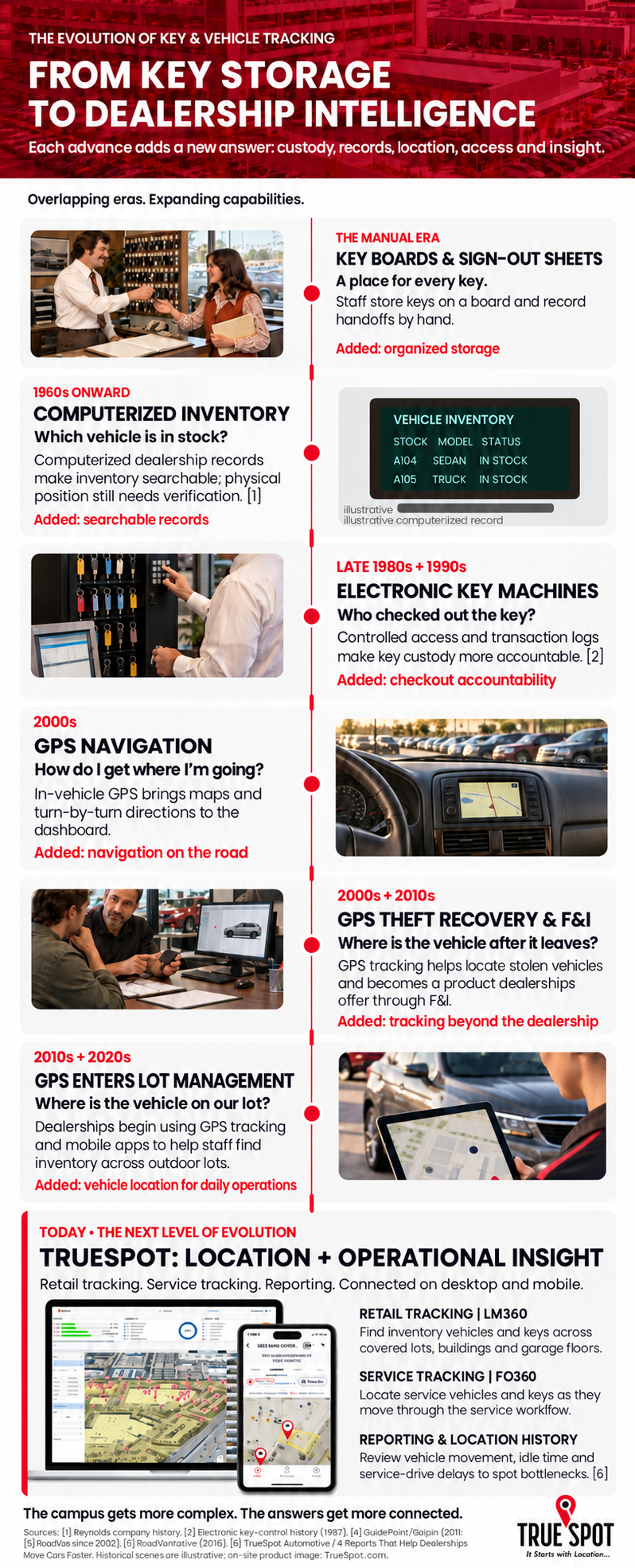
The timeline below shows how the questions changed as new capabilities became available.
First, dealerships needed somewhere to store keys. Then they needed searchable inventory records and a way to manage key access. Navigation and vehicle tracking made location information useful in new ways, including finding inventory on dealership lots.
These capabilities overlap. Many stores use several of them together, and each still serves a purpose.
Each advancement answered a new question
Key boards gave keys a home. Computerized inventory made vehicle records searchable. Electronic key machines added access control and checkout accountability.
GPS brought location into the picture—from navigation and theft recovery to finding inventory across dealership lots.
Each capability remains useful. As dealerships grow, the questions expand: Where is the vehicle inside the building? Where are its keys? How long has it been waiting for the next step?
That is where connected dealership tracking adds another layer.
What does connected dealership tracking add?
TrueSpot applies real-time key and vehicle tracking to retail and service operations. With a properly configured AQFind network, dealerships can provide location visibility across covered outdoor areas, buildings, and parking structures.
Employees access that information through phones, tablets, or computers. Lot Management 360 supports retail assets, while Fixed Ops 360 supports service keys and vehicles.
This adds a shared source of location information to the tools and processes the store already uses.
A key-control system can manage access. Inventory software can maintain the vehicle record. Location tracking can help the employee find the assets needed to act on that record.
For a busy store, that connection matters at every handoff.
How can better visibility help the dealership day to day?
Picture a used vehicle moving from acquisition to the front line.
It needs an inspection, repairs, detail, and photos. Different employees handle different steps. The car moves, and its keys move too.
When the next person cannot find what they need, the work pauses. Someone starts making calls. Another employee joins the search. A manager gets interrupted.
Better visibility gives the team a clearer starting point.
In sales, that can help an employee prepare a vehicle before an appointment. In service, it can help a technician locate the next unit. In recon, it can help the person responsible for a handoff find the car and get it to the next department.
These are ordinary moments. They are also the moments that determine whether the day stays on schedule.
How can dealership reporting help managers spot delays?
Current location helps someone find an asset. Location history helps a manager examine what happened over time.
TrueSpot reporting includes idle-vehicle, movement-history, and service-drive-delay reports. Managers can use that information to identify a unit that deserves attention and investigate why it is waiting.
Imagine a vehicle that has remained near detail longer than expected.
The location tells the manager where to look. The waiting time prompts the conversation. Is the work complete? Is someone waiting for approval? Who owns the next handoff?
A report cannot answer every operational question on its own. Its value is making a delay visible so the team can investigate and act.
Explore four TrueSpot reports that help dealerships move cars faster.
Where can dealerships go from here?
A store can start with one recurring problem and build from there.
Maybe sales frequently searches for keys. Maybe service vehicles are difficult to find. Maybe recon managers struggle to identify which units are waiting between departments.
Choose a problem the team recognizes. Define who will use the location information, what action they should take, and what improvement you want to measure.
Useful measures might include:
- Time spent searching for keys and vehicles
- Customer waits before demonstrations or pickup
- Delays between recon handoffs
- Time required to get inventory frontline-ready
That creates a path from finding assets to improving the process around them.
The longer-term opportunity is an operation where location information helps employees coordinate work and gives managers evidence to review recurring delays.
Why does the value extend beyond lost keys?
Replacing a lost key is an obvious expense. A misplaced key can also consume time even when it turns up later.
The salesperson waits. The customer waits. A porter stops another task to help. The manager answers another call.
Those interruptions belong in the value conversation alongside replacement costs.
When evaluating tracking, ask how often searches happen, who gets involved, and which tasks get delayed. That will give you a fuller picture of the problem your dealership is trying to solve.
See what the next stage could look like at your dealership
What does your team do today when a key or vehicle is difficult to find?
Walk the lot? Check another building? Call around until someone remembers?
Schedule a TrueSpot demonstration to explore how connected key and vehicle tracking could support your store’s sales, service, and recon workflows—and how reporting could help your managers investigate delays.

Frequently Asked Questions
What is the difference between key control and key tracking?
Key control manages storage, access, and checkout records. Key tracking helps employees locate a tagged key after it moves. The two capabilities can work together.
Is dealership tracking the same as in-vehicle navigation?
Navigation helps a driver reach a destination. Dealership asset tracking helps staff locate vehicles and keys for work around the store.
Can TrueSpot track keys and vehicles inside dealership buildings?
Yes. A configured TrueSpot AQFind network can support tagged assets in covered indoor areas and parking structures, as well as outdoor lots. Coverage should be planned around the property.
Can location data show why a vehicle is delayed?
It can reveal movement and waiting patterns that warrant investigation. Staff still need to determine the cause and the next action.
Where should a dealership start?
Start with a frequent search or handoff problem. Identify the assets and areas involved, involve the employees responsible, and agree on how to measure improvement.