What the 2026 J.D. Power Vehicle Dependability Study Means for Dealers
For decades, vehicle dependability was measured by one question:
Would the engine, transmission, or drivetrain last? Today, reliability means something different.
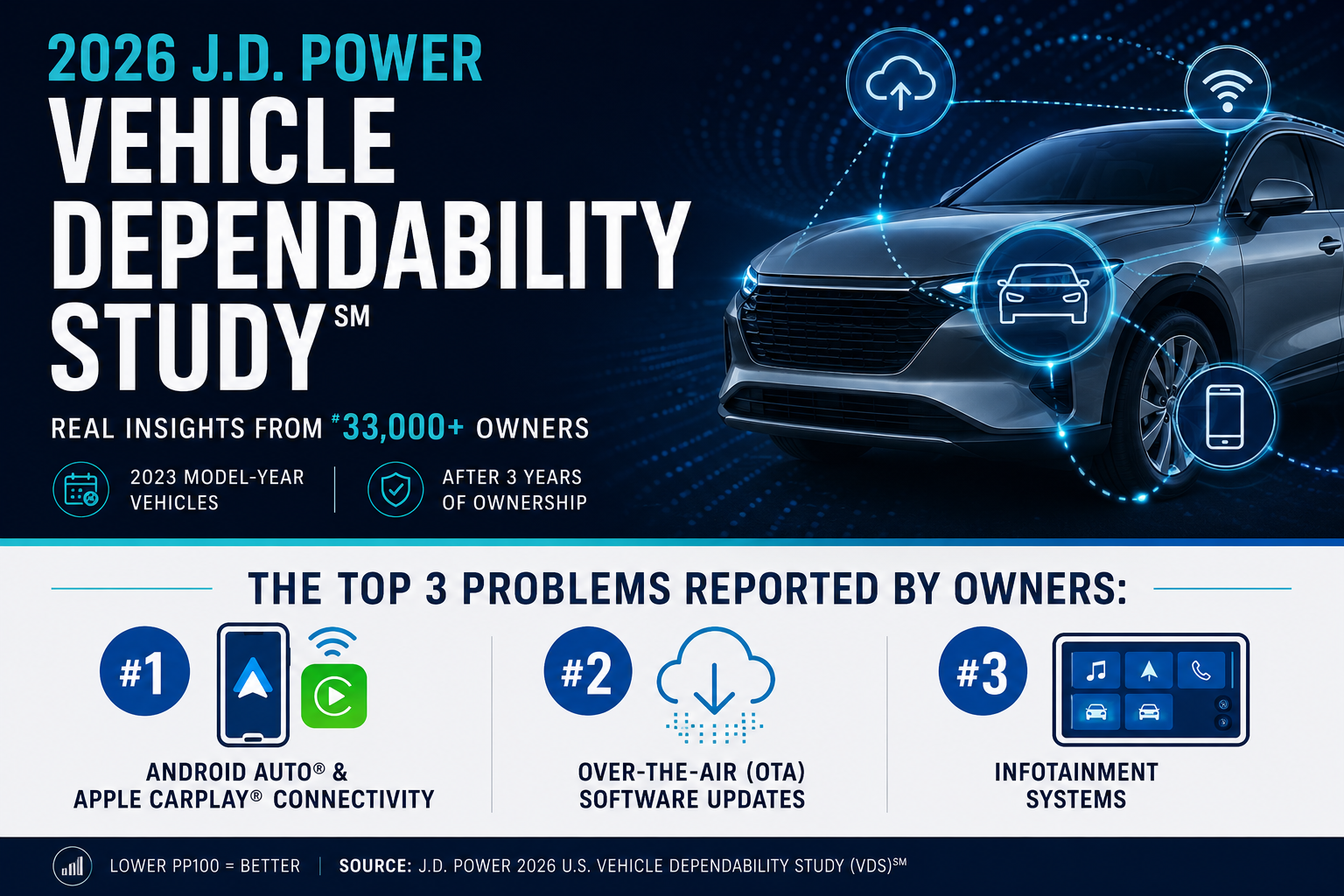
According to the 2026 J.D. Power U.S. Vehicle Dependability Study, the most frequently reported problems after three years of ownership are no longer major mechanical components.
Instead, owners are increasingly frustrated by vehicle technology.
Key Takeaways
- Software-related issues are now among the most commonly reported vehicle problems.
- Android Auto® and Apple CarPlay® connectivity ranked as the top reported concern.
- Over-the-air (OTA) software updates and infotainment systems followed closely behind.
- Lexus ranked highest among premium brands, while Buick led mass-market brands.
- Modern vehicle reliability increasingly depends on software—not just mechanical components.
By the Numbers
| Metric | Result |
|---|---|
| Owners Surveyed | 33,000+ |
| Model Year Evaluated | 2023 |
| Ownership Period | 3 Years |
| Industry Average | 204 PP100 |
| Premium Brand Leader | Lexus |
| Mass-Market Brand Leader | Buick |
Which Brands Ranked Highest?
J.D. Power measures long-term dependability using Problems Per 100 Vehicles (PP100). Lower scores indicate fewer reported problems and better reliability.
For example, a score of 151 PP100 means owners reported 151 problems for every 100 vehicles after three years of ownership.
The industry average was 204 Problems Per 100 Vehicles (PP100), the highest average recorded since J.D. Power redesigned the study in 2022.
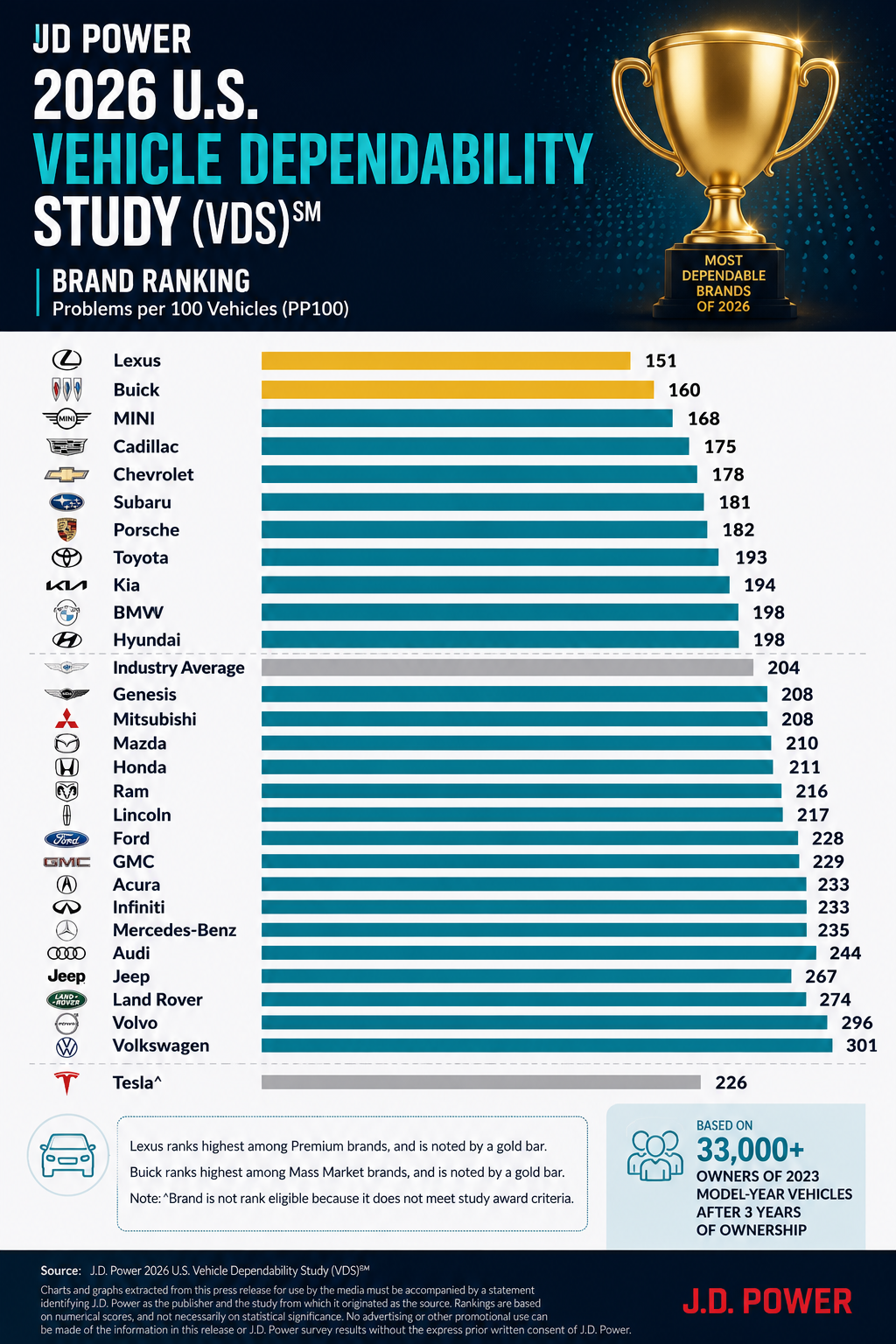
What Stands Out
A few trends immediately jump off the page:
- Lexus continues to lead premium brands for long-term dependability.
- Buick finishes as the highest-ranked mass-market brand.
- Toyota, Subaru, Mazda, and Honda remain clustered around or better than the industry average.
- Several brands traditionally known for luxury continue to battle increasing software complexity.
The rankings show that while mechanical quality remains strong across much of the industry, digital experiences are becoming a much larger part of overall vehicle reliability.
What Surprised Us Most
Perhaps the biggest takeaway isn't which brand finished first.
It's what owners are reporting.
For decades, dependability studies focused on engines, transmissions, suspension components, and electrical failures.
Today, the most common complaints involve:
- Smartphone connectivity
- Software updates
- Touchscreen responsiveness
- Infotainment systems
Modern vehicles have become rolling computers.
That means reliability is increasingly defined by the owner's digital experience—not just mechanical durability.
Reliability Has Changed
Customers now expect their vehicle to perform much like their smartphone.
They expect:
- Wireless Android Auto® and Apple CarPlay®
- Reliable navigation
- Fast touchscreen response
- Over-the-air software updates
- Mobile app connectivity
- Digital displays that simply work
When those features fail, owners often perceive the entire vehicle as less dependable—even if it has never experienced a mechanical issue.
That's a significant shift from just ten years ago.
Instead, owners are increasingly frustrated by vehicle technology.
Vehicles now contain hundreds of millions of lines of software code, powering everything from smartphone integration to navigation, driver assistance features, and over-the-air updates.
As manufacturers add more connected technology, the opportunity for software-related issues naturally increases—even when the vehicle itself is mechanically sound.
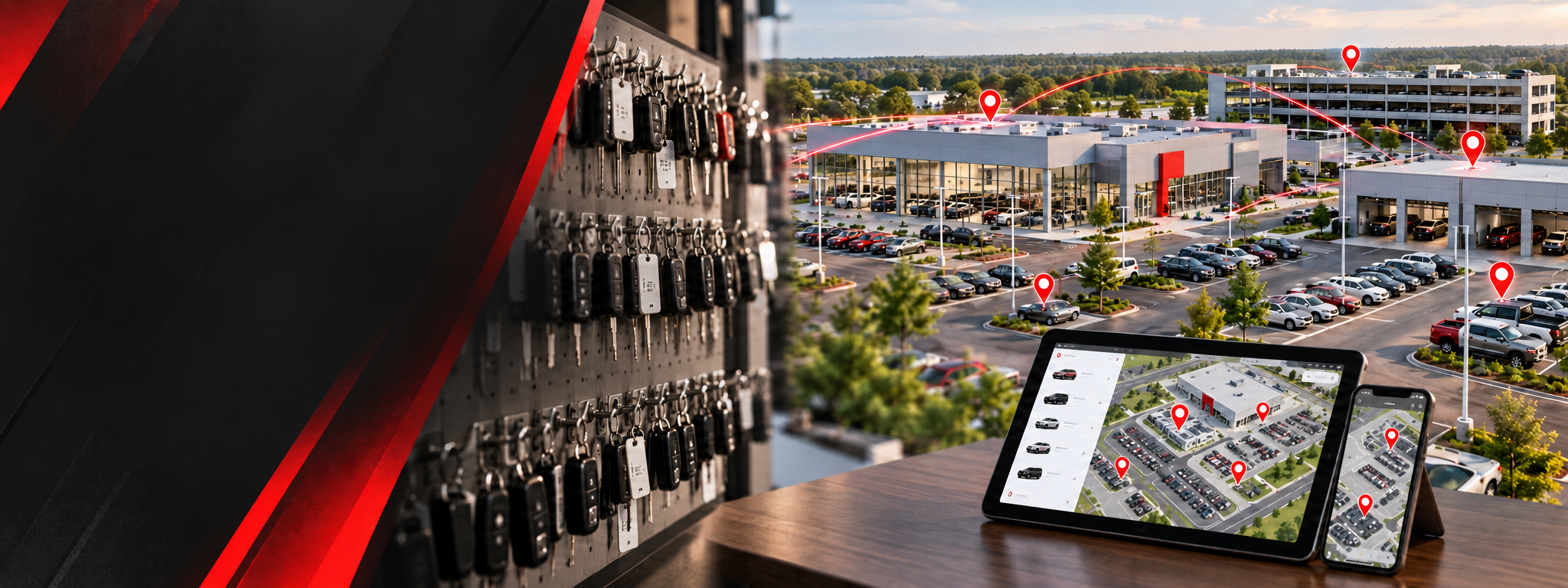
Technology is changing more than just the vehicles—it is also changing dealership operations.
As vehicles become more connected, dealership operations have become more technology-driven as well.
Employees rely on technology to locate and manage:
- Vehicle keys
- Inventory vehicles
- Dealer plates
- Diagnostic scan tools
- Tablets
- EV charging adapters
- Shared service equipment
Just as customers expect technology to make their vehicles easier to own, dealership employees expect technology to make their jobs easier.
Real-Time Location Systems (RTLS) help dealerships instantly locate these assets, reducing wasted time and allowing staff to focus on serving customers instead of searching parking lots and service bays.
If you're interested in dealership technology, you may also enjoy:
- How Dealerships Track Vehicle Keys
- How Dealerships Track Dealer Plates
- How Dealerships Track Vehicles Across Multiple Lots and Parking Garages
The Bottom Line
Vehicle reliability has entered a new era.
Mechanical quality remains incredibly important, but software now plays an equally significant role in how owners judge their vehicles.
Manufacturers that deliver reliable digital experiences—not just reliable engines—will likely have the strongest long-term ownership satisfaction.
Likewise, dealerships that embrace technology to improve daily operations will be better positioned to deliver the efficient customer experience today's buyers expect.
Frequently Asked Questions
What is the J.D. Power Vehicle Dependability Study?
The J.D. Power Vehicle Dependability Study measures long-term vehicle reliability based on problems reported by owners after three years of ownership.
What does PP100 mean?
PP100 stands for Problems Per 100 Vehicles. Lower scores indicate fewer reported problems and higher dependability.
Which brand ranked highest in the 2026 study?
Lexus ranked highest among premium brands, while Buick ranked highest among mass-market brands.
Why are software issues becoming more common?
Modern vehicles include significantly more connected technology than previous generations. As features like smartphone integration, infotainment systems, and over-the-air updates become standard, software-related issues account for a larger share of reported owner concerns.
Source: J.D. Power, 2026 U.S. Vehicle Dependability Study (VDS).
How Rusty Wallace Chevrolet Solved the Invisible Key Problem | Dealership Key & Vehicle Tracking
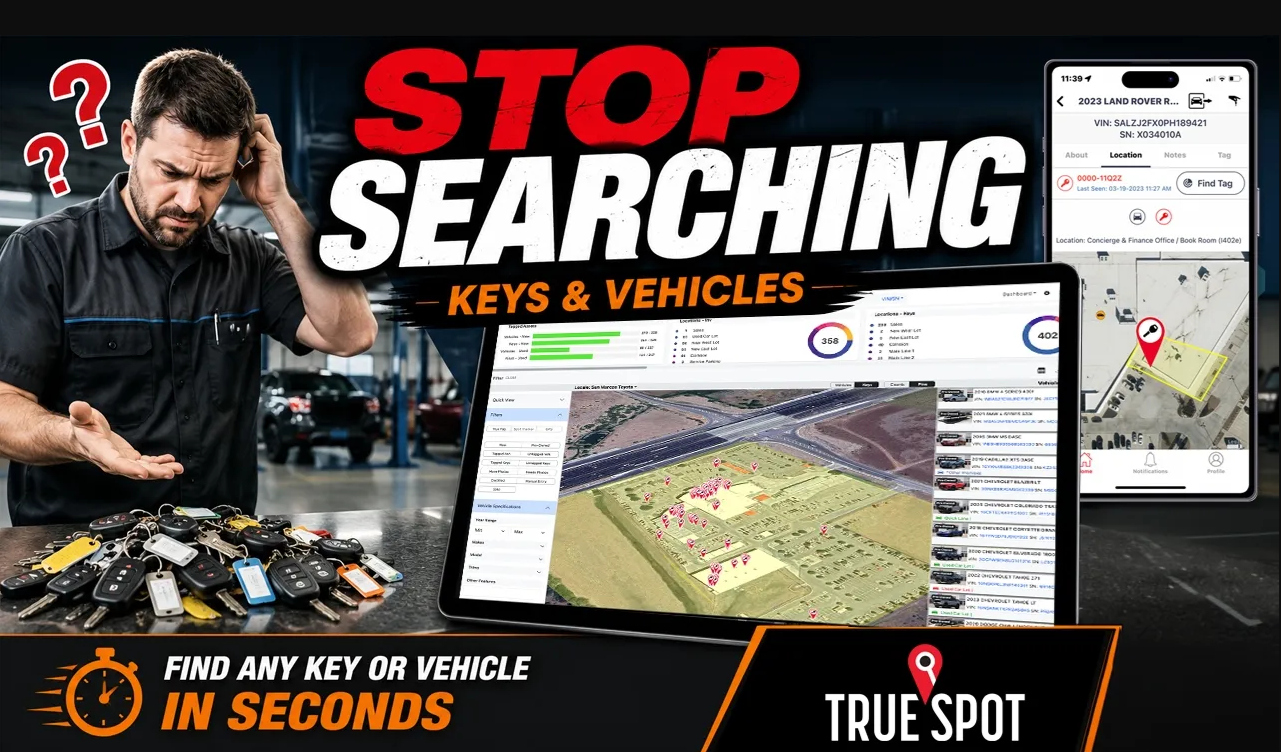
Stop Searching for Keys & Cars | Fixed Ops 360 for Service Departments