Every dealership has them. Yet many dealerships don't have a fast way to answer one simple question: "Where's the dealer plate?"
Dealer plates often become the first "non-traditional" asset dealerships choose to track after implementing vehicle or key tracking. Once managers see how much time is saved, they frequently expand the same RTLS network to gas cards, diagnostic equipment, jump boxes, battery chargers, EV charging adapters, and other shared assets. Because the infrastructure is already in place, adding another tracked asset is often as simple as attaching another Bluetooth tag.
A salesperson is ready for a customer test drive.
A service advisor needs one for a loaner vehicle.
A porter is preparing a dealer trade.
Everyone assumes the dealer plate is somewhere in the dealership... until nobody can find it.
Employees begin checking desks, walking the lot, calling coworkers, and asking the same question:
"Who had it last?"

Most dealer plates aren't permanently lost.
They're simply misplaced.
The problem is the time wasted before they're found.
Why Dealer Plates Are Difficult to Manage
Dealer plates are constantly moving throughout the dealership.
Unlike inventory vehicles, they're removed and reinstalled throughout the day.
A dealer plate might be:
- Attached to a test drive vehicle.
- Left on a service loaner.
- Sitting on a salesperson's desk.
- In the detail department.
- At a collision center.
- At an overflow lot or parking garage.
- Accidentally taken home by an employee.
In most cases, the dealer plate is still somewhere.
The challenge is knowing exactly where.
The Hidden Cost of Searching for Dealer Plates
Many dealerships eventually find misplaced dealer plates.
But consider how much time is lost before that happens.
Here's one example.
Imagine it takes 30 to 45 minutes to locate a misplaced dealer plate.
Now imagine that happens just twice each week.
What Does That Add Up To?
| Time to Locate | Occurrences Per Week | Hours Lost Per Year |
|---|---|---|
| 30 minutes | 2 | 52 hours |
| 45 minutes | 2 | 78 hours |
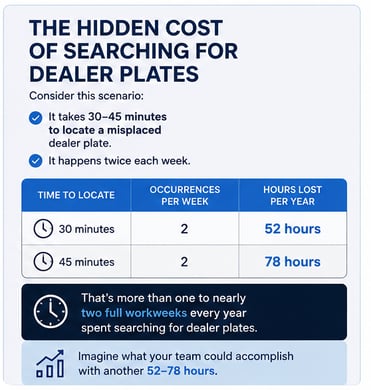
That's the equivalent of more than one to nearly two full workweeks every year spent searching for dealer plates.
Now ask yourself...
What could your team accomplish with another 52 to 78 hours?
- More customer test drives.
- Faster vehicle deliveries.
- More time selling vehicles.
- Faster service operations.
- Less frustration across departments.
The goal isn't simply to recover a misplaced dealer plate.
It's to eliminate the time spent searching for it.
Losing a Dealer Plate Creates More Than Lost Time
Dealer plates aren't just another dealership asset.
In many states, they're official license plates issued through the Department of Motor Vehicles (DMV).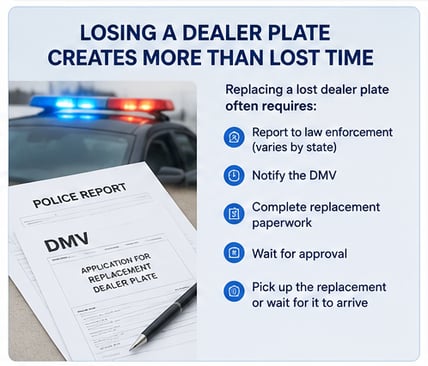
If one can't be located, replacing it may require the dealership to:
- Report the missing plate to law enforcement (depending on state requirements).
- Notify the DMV.
- Complete replacement paperwork.
- Wait for approval.
- Pick up the replacement or wait for it to arrive.
Even if the replacement fee itself isn't substantial, the administrative time and operational disruption can quickly become far more expensive.
Dealer Plates Also Create Accountability Concerns
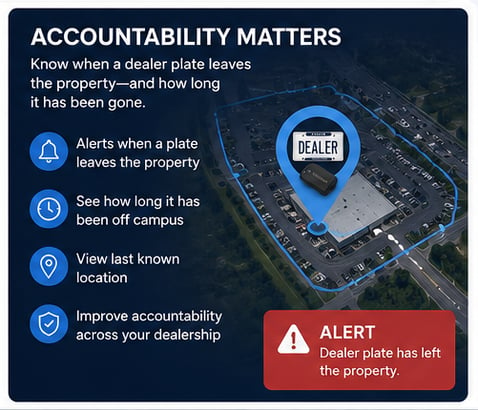 If a dealer plate leaves the property unexpectedly, the dealership may not know until someone needs it.
Maybe it was:
- Left on a vehicle after a dealer trade.
- Forgotten on a loaner vehicle.
- Accidentally taken home by an employee.
- Misplaced at another dealership location.
- Simply forgotten after a busy day.
The longer a dealer plate is missing, the more difficult it can become to determine where it went.
Having visibility into when a dealer plate leaves the dealership—and how long it has been off campus—can help managers identify potential issues much sooner.
How Modern Dealerships Track Dealer Plates
Many dealerships are now attaching Bluetooth tracking tags directly to their dealer plates...
Instead of asking around the dealership, they simply search for the asset.
See Dealer Plate Tracking in Action
Reading about dealer plate tracking is one thing.
Seeing how quickly a dealership can locate a misplaced dealer plate is another.
Watch this short demonstration to see how TrueSpot tracks dealer plates in real time, provides off-campus alerts, and helps dealerships locate shared assets in seconds.
Dealer Plates Are Just One Asset Worth Tracking
One of the biggest advantages of a dealership-wide RTLS network is that it can track far more than dealer plates.
Many dealerships also use the same system to locate: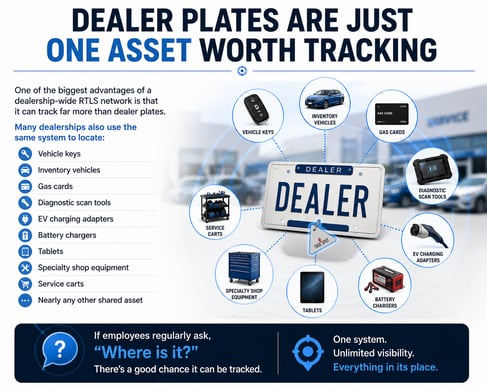
- Vehicle keys
- Inventory vehicles
- Gas cards
- Diagnostic scan tools
- EV charging adapters
- Battery chargers
- Tablets
- Specialty shop equipment
- Service carts
- Nearly any other shared asset
If employees regularly ask,
"Where is it?"
There's a good chance it can be tracked.
One Network. Multiple Problems Solved.
Many dealerships begin by tracking keys because they're one of the most searched-for assets in the store.
Later they expand to inventory vehicles.
Eventually they realize the same tracking network can also eliminate the daily search for dealer plates, gas cards, tools, chargers, and dozens of other shared assets.
Instead of purchasing separate systems for different equipment, dealerships can use one RTLS network to improve visibility across their entire operation.
Final Thoughts
Every minute spent searching for a dealer plate is a minute your employees aren't serving customers.
Most misplaced dealer plates are eventually found.
The question is how much time was wasted before they were.
Real-time location technology gives dealerships immediate visibility into where their dealer plates are, when they leave the property, and how long they've been gone.
And because the same network can also track keys, vehicles, gas cards, tools, and other shared assets, many dealerships discover that solving one problem leads to greater efficiency throughout the entire dealership.