AI Is Taking Over Dealership Operations—But Here’s What Actually Matters
If you walked the floor at NADA 2026, you heard the same thing everywhere: AI. Every vendor is talking about it, every demo includes it, and every roadmap depends on it.
We were there as well—running demos, meeting with clients, and having real conversations with dealers about how these tools actually perform in the store. And one thing stood out quickly.
Dealers aren’t asking what AI can do anymore—they’re asking how it actually helps their store run better.
How does it make the service lane move faster?
How does it reduce friction for the team?
How does it help cars move through the lot more efficiently?
Because the reality is, most stores are still dealing with day-to-day execution challenges.
And when AI gets introduced into that environment, it doesn’t fix those issues—it exposes them.
And That’s Where Things Start to Break Down
On the surface, AI promises to fix exactly that—more automation, better decisions, faster workflows. But inside the dealership, that’s not what’s happening.
The Real Problem Isn’t AI—It’s What AI Can’t See
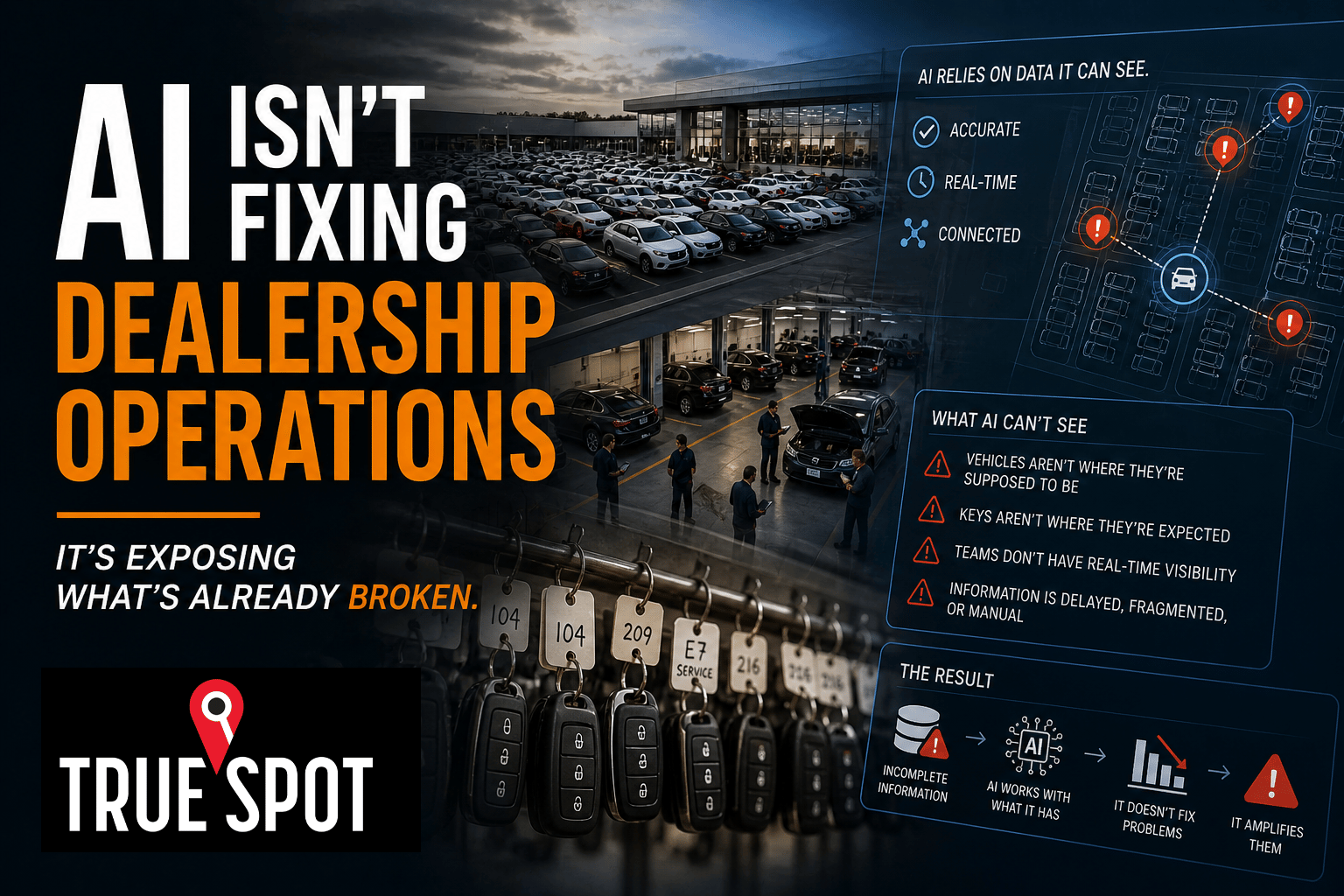
AI isn’t fixing dealership operations—it’s exposing what’s already broken.
Most AI tools depend on data being accurate, real-time, and connected across systems. That’s where things start to fall apart.
Inside most dealerships:
- Vehicles aren’t where they’re supposed to be
- Keys aren’t where they’re expected
- Teams are operating without real-time visibility
- Information is delayed, fragmented, or manual
So instead of improving operations, AI ends up working with incomplete information. And when that happens, it doesn’t fix problems—it amplifies them.
What This Actually Looks Like Inside a Dealership
This isn’t theoretical. We saw this firsthand in conversations with dealers and in real store operations.
In one of our dealership walkthroughs, a dealership put it simply:
“Most dealerships think they have control of their service lane… until an advisor needs to find a key — and the car that goes with it.”
That’s the moment where most operations break down.
On paper, everything looks organized. But in practice, advisors are tracking down vehicles, technicians are waiting on keys, and customers are sitting while teams try to locate cars.
What looks like a small issue turns into slower service throughput, frustrated staff, and a worse customer experience.
This is the gap most dealerships are still operating in.
Where TrueSpot Fits In (And Why It Matters)
Earlier, we talked about where AI is already being applied:
- Automating repetitive workflows
- Improving service lane decision-making
- Enhancing marketing and lead conversion
- Optimizing inventory merchandising and pricing
Those are the outcomes every dealership wants.
But they all depend on one thing:
Accurate, real-time operational data.
That’s where TrueSpot comes in.
Connecting Visibility to Real Dealership Outcomes
TrueSpot doesn’t replace AI. It makes it work.
Automating Repetitive Workflows
A surprising amount of dealership “work” is actually searching—looking for keys, finding vehicles, and trying to figure out what moved where.
With TrueSpot, that time goes away. Staff know exactly where things are, and workflows move faster without adding headcount.
That’s real operational efficiency before AI even enters the picture.
Improving Service Lane Decision-Making
Service operations break down when there’s no visibility.
Advisors and technicians lose time trying to locate vehicles and keys instead of moving work forward.
With real-time visibility, decisions happen faster. Vehicles move through the lane more efficiently, and bottlenecks are easier to spot.
Enhancing Sales and Lead Conversion
Speed matters when a customer is ready to buy.
If a vehicle can’t be located quickly, the experience breaks down.
TrueSpot helps teams retrieve vehicles faster, coordinate better, and keep test drives moving without delays.
Less friction leads to better conversion.
Optimizing Inventory and Merchandising
Inventory performance isn’t just about pricing—it’s about movement.
With better visibility and reporting, dealerships can see:
- Which vehicles are sitting too long
- Where delays are happening in recon or prep
- Whether high-demand units are actually accessible
That shifts inventory management from reactive to proactive.
Visibility Is Step One—Reporting Is Where the Value Multiplies
Knowing where things are is powerful. Understanding how they move is where the real value shows up.
TrueSpot’s analytics layer, built on Microsoft Power BI, turns real-time tracking into usable insight.
Dealerships can:
- Track movement history for vehicles and keys
- Identify idle time and delays
- Monitor test drive activity
- Surface exceptions, like keys leaving designated areas
This is where data becomes something you can actually act on.
See It in Action
If you want to see how this plays out inside real dealerships, here are a couple examples.
Retail (Sales and Inventory Tracking)
These show how dealerships are managing large lots, reducing search time, and improving how quickly vehicles get to customers.
Fixed Ops (Service Lane Tracking)
These focus on service operations—locating keys, improving flow, and reducing delays inside the service lane.
The Future Isn’t Just AI—It’s AI + Visibility + Reporting
The biggest takeaway from NADA isn’t just that AI is growing.
It’s that AI is becoming part of how dealerships are expected to operate day to day.
But it only works when it’s built on a solid foundation:
- Visibility
- Reporting
- Then AI on top of both
Dealerships that get this right won’t just be more efficient.
They’ll have a level of operational control most stores don’t.
Final Thought
Everyone is talking about AI.
But the real advantage isn’t adopting more tools.
It’s building the foundation that allows those tools to actually work.
Because in the end, the dealerships that win won’t just use AI.
They’ll give it the data it needs to make real decisions.
This is what separates stores experimenting with AI… from the ones actually benefiting from it.
Want to see how this could work in your store? Schedule time with us here.