Maybe It’s Time to Rethink RTLS
For years, real-time location systems were associated mostly with large health systems that had sprawling campuses and hundreds of beds. If you worked in a community hospital or ambulatory surgery center, RTLS may not have seemed relevant or realistic.
But the business of healthcare has changed. So has RTLS.
Community hospitals are being asked to do more with fewer resources. Staffing shortages, reimbursement challenges, and tight budgets leave no room for wasted time or equipment with low utilization.
Ambulatory surgery centers face a different version of the same challenge. Because they depend on keeping procedures moving, time spent searching for equipment is an efficiency killer. Every hiccup in the schedule can limit the number of patients a facility can treat.
In both settings, being able to find critical equipment quickly is more than a matter of convenience. It can directly affect operational performance.
Small searches add up
The time spent looking for a wheelchair, infusion pump, or other critical asset may seem insignificant in the moment, but those interruptions add up quickly.
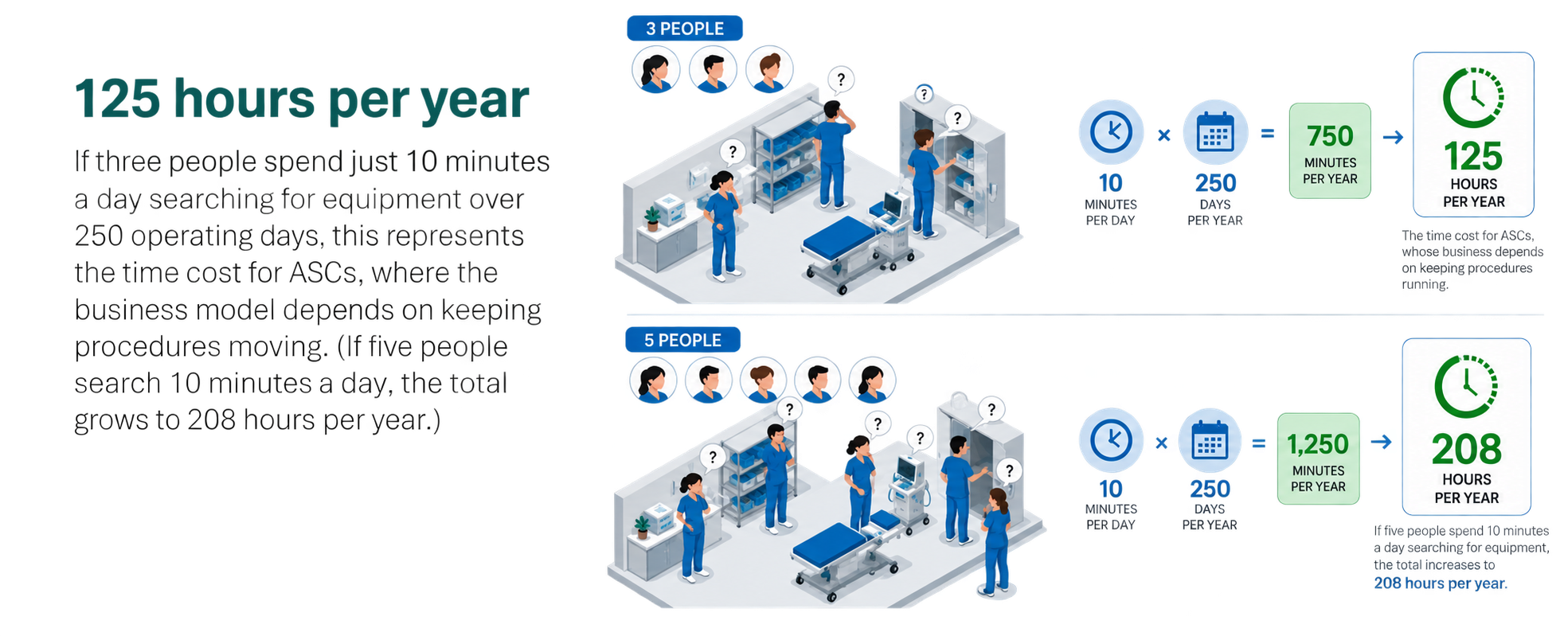
Say three employees each spend 10 minutes a day searching for equipment. Over 250 operating days, that represents 125 hours of staff time each year. If five employees spend the same amount of time searching, the total grows to more than 200 hours.
The consequences go deeper than lost time. Missing equipment contributes to unnecessary rentals, disrupted handoffs, and frustration for staff members already working under pressure.
A more practical way to begin
Your organization doesn’t necessarily need to start with a system-wide RTLS deployment. Maybe you can focus on one recurring operational problem.
Maybe you are asking, “Should we invest in RTLS?”
The better question might be, “What operational problem would we like to solve?”
You could try to cut the time spent searching for equipment or stop unnecessary rental costs. Perhaps your team has no idea if your most critical assets are available or where they are being used at any given moment.
Newer RTLS solutions are easier to deploy and maintain, making them practical for organizations that once assumed they were out of reach.
TrueSpot helps healthcare organizations start small, measure the results, and expand where it makes sense. The goal is not to implement technology for technology’s sake. It is to solve operational problems that affect staff efficiency, asset utilization, and patient care.
The question is no longer whether your organization is large enough for RTLS.
It’s whether you have an operational problem worth solving.